A Patient Story: Message from a Vietnam Veteran

I’ve had ET for 32+ years and probably longer just undetected. I am a Vietnam Veteran who was exposed to Agent Orange from 1968 until my tour of duty ended. After my ET was diagnosed I filed a claim in 1990, and the VA handled it very poorly, especially back in the early 90s. After many years, the claim was officially denied, but I tolerated Hydroxyurea and got on with my life.

Fast forward to just 4 years ago and a phone conversation with a woman named Ann from an MPN advocacy group. What an education I received that day. I was enlightened and realized I was being fed bogus information regarding MPNs and veterans for too many years. In 3 short weeks, I was attending a conference at the Marriott in St. Petersburg, Florida, and discussing MPNs and my ET with a specialist from the Moffitt Cancer Center. I now see Dr. Kuykendall annually at Moffitt in Tampa supplementing my VA appointments.

Sincere heartfelt thanks to you MPN Advocacy and Education International for the warp-speed education and reigniting my motivation to reengage with the VA. I did a bunch of research, obtained new Nexus statements from the Oncologists linking Agent Orange (AO) exposure to my MPN, and found numerous medical journal articles regarding MPNs and toxins. I submitted a new claim in 2019 and provided a detailed 3+ decade medical summary with new supporting resource documentation. As expected, my new claim was summarily rejected and kicked to the curb. The VA indicated the reason for denial was that nothing new had been submitted with the claim, go figure!

I naturally appealed the case and finally had a hearing with an appeals board judge in July of this year, 3 years after my initial claim. The judge seemed irritated and appalled the VA claim’s reviewer totally dismissed and ignored all of my supporting documentation, including nexus statements from 2 oncologists supporting the link between AO exposure and my ET.

I just received this past weekend the official VA letter indicating my claim and appeal has been granted. Again, many thanks to MPN Advocacy and Education International for emboldening me to reengage the VA.

It is unfortunate the VA has all the leverage in the MPN cases. As I discovered, even though there are probably hundreds of successful claims for MPNs, every case is handled individually and goes back to square one. So, unlike a conventional court of law, precedent is not taken into account and the entire burden of proof is on the veteran. The level of a veteran’s persistence and determination, individual skills for record keeping, and obtaining all the appropriate documentation over many years, govern the outcome when battling the VA bureaucracy. Thank you for being a large part of helping me navigate the maze.

Sincerely,

Lawrence M.

A Patient Story: My Journey to a Better Life

By Mayra D.

My Primary Myelofibrosis journey started on a festive Cinco de Mayo in 2015 while I was at work. Without any warning, I started to feel sick to the point that I almost collapsed at my desk. I still remember this incident like it was yesterday. I was sweating and had an awful pain in my lower back that kept me out of my chair. I had very severe discomfort in my upper abdomen that was not an ordinary stomach pain. At that moment I knew I was struggling health-wise. I was feeling so weak and so out of balance, things I had never felt or experienced before in my life. After this scary episode, I was rushed to the ER. When I got to the hospital, I was not able to walk, and breathing was very difficult. Even holding my cell phone was a challenge. I was admitted right away due to the fact that my hemoglobin was very low among other things. After a bunch of blood transfusions, IV treatments, and everything in between, the doctors were able to stabilize my condition. After a week I was released from the hospital and started what I called ‘My Health Crisis Path’.


I started to see an Oncologist/Hematologist on a regular basis. One year later, I was rushed to the ER once again. At first the doctors thought I was pre-menopausal and that was the cause of the anemia.  No, it wasn’t!  The severe night sweats, the awful skin itching, especially after taking a shower, the painful feet, and leg cramps at night while in bed, and the severe anemia, were all part of a few of the new symptoms I was experiencing. Overall, my health was not improving, and I was feeling weaker every day. After a year and a half of trying new treatments with no diagnosis, the Oncologist/Hematologist team decided that the next step for me was a bone marrow biopsy. Everything became crystal clear with my ‘Jak 2 Mutation’ and the finding of Primary Myelofibrosis (MF).  


This health crisis of mine impacted me and my entire family.  My husband got so overwhelmed he even lost his job. I was forced to resign from my job and my husband losing his caused a great struggle financially. It was okay, and we managed together as a family, but having him by my side every step of the way was more important and something money can’t buy.


On the other hand, my daughter, who was only 14, felt like she was losing her mom. She reached rock bottom not only emotionally but academically.  Today I can say joyfully my daughter is now 21 years old and is a successful college student attending a State University. Through all of this, we saw a psychiatrist and had a few counseling sessions in order to help us individually and as a family cope with this unexpected health crisis. It has helped us with the healing and moving forward process.  Our daughter once said: “We are a family no one left behind.”


I used to donate blood and today I am on the other side of the chair. My driver’s license even says that I am an organ donor. Slowly but surely, I started to accept the fact that I suffered from a rare chronic blood disorder. I had two options in front of me, either feel sorry for myself and do nothing about it or go out there and make a difference. I chose the second option. It was not an easy task. In the beginning, I felt alone and confused, and I didn’t know where to go for help, support, and answers. When I heard the word ‘cancer’ for the first time it was a feeling I can’t explain. But this didn’t stop me. 


Being a former graphic designer, I was used to putting on a creative hat, so I knew what to do next. I began by researching about MPN in general. In the process, I came up with what I called ‘My 4 Daily Elements’: Chemo-Tablet Treatment, Anti-Inflammatory Nutritional Meal Plan, Routine of Exercise, and Mindfulness (I want to point out that when I started this health journey there was not much guidance like there is today). A few years ago, I received a couple of certificates in Modeling and Acting from a local school, so I decided to take advantage and use these tools. This knowledge and experience are my platform for cancer awareness. Today I’m proud to say I’m a member of a Cancer Support Community at the cancer institute in Orlando, FL. I’m also a member of MPN groups on social media. I was interviewed a couple of years ago and an article of my journey was published in Prevention Magazine. What an honor it was being able to speak about this rare and chronic blood disorder. We may be a small group, but our voices can make a big difference.


I am also the voice in the Latino community. I spoke on a local radio station where I was able to bring awareness to Central Florida. In my message I let the listeners understand that talking about cancer doesn’t make you a victim or a weak person, it makes us stronger by informing others. I even asked one of the CSC-Mental Health Therapist to join me for another live radio chat so we could talk about integrative medicine and what it offers the cancer community.


Next month, I’m going to attend my first meeting as part of the Patient and Family Advisory Council at Orlando Health. In December I’m also going to be participating in the Sea World 3 Mile Reindeer Run for pediatric cancer and bone marrow transplant programs at AdventHealth for the second year. Sharing my story is very important to me. If I can shed light, hope, and support to others then my mission is accomplished. “ME with a Purpose.”


Patient Story: Living with MF at 82 years old

In 1992, I was a Technical Service Representative for a major chemical company, working with clinical laboratories, when I learned through my yearly medical checkup that my platelet count was significantly elevated.  A CBC confirmed what I suspected, essential thrombocythemia (ET). “Enjoying” the first of many bone marrow biopsies proved the diagnosis to be correct.  I met with a pathologist friend and he explained the prognosis.  Except for the elevated platelets I had no other symptoms.


Fast forward to 2004.  I’m having bloodwork checked by a hematologist prior to minor surgery.  I still had no physical symptoms of a myeloproliferative disease.  He came back into the waiting room and announced, “You have morphed into myelofibrosis.”   I didn’t want to believe it, but I knew as a certified medical technologist, MT(ASCP), that the cells don’t lie!  Years of nervous waiting followed, until in 2009 I began to experience terrible pruritis and increasing fatigue.  It was time to move to the next step.

I checked with Mayo Clinic in Scottsdale, Dr. Reuben Mesa, and with M.D. Anderson in Houston, Dr. Srdan Verstovsek.  Sure enough, the myelofibrosis was progressing and I was positive for the JAK-2 mutation.  “Dr. V” told me that a new Phase III study was to start, and that an oncologist/hematologist in San Antonio was enrolling in the study.  That was good news.  San Antonio was much closer to home!

I found my hero, Dr. Roger Lyons, now retired.   After more bloodwork, more bone marrow biopsies, he thought I was a good candidate for the Comfort I study, the first Phase III ruxolitinib study.  It was of course a doubleblind study, but by the third week of the study I knew that I had not drawn a placebo!  The itching began to cease and I felt normal. I stayed in the study through completion, and continued on what came to be called Jakafi for quite a while after.  It was a miracle!  The first drug successfully developed to treat myelofibrosis!

Then there was a problem.  In 2018, I began to develop growths on my nose.  No one suspected it had anything to do with Jakafi. When every dermatologist had exhausted the list of probable diagnoses, Dr. Lyons gave permission to discontinue the Jakafi to see what would happen.  Again, as when I started ruxolitinib, I knew very quickly that Jakafi was the culprit.  Not good news, but the positive effects of the Jakafi stayed with me for over two years.  Luck is really on my side.

Pruritis began anew in 2020, my white blood count had begun to increase, and Dr. Lyons had retired, but fortune smiled again.  Dr. Mesa, who I’d seen years ago at Mayo Clinic Scottsdale, had come to the University of Texas Health Science Center San Antonio as the head of a new partnership with M.D. Anderson Cancer Center.  As my new doctor he suggested we try Jakafi again and adjust the dose as required.  Now I take 20 mg Jakafi daily.  I’m feeling well, considering my 82 years.


A Patient Story: A Physician Shares his MPN Diagnosis

By Dr. Howard S.
The biggest burden I experience with my diagnosis of secondary (post PV) myelofibrosis, 21 months ago, is anxiety for my future. I am a family physician, so I knew what it meant when I no longer needed to phlebotomize after a
20-year run with polycythemia vera. For the last 10 years I injected Pegasys weekly at the top dose without any side effects and excellent control of my platelet and white blood cell count. I still required phlebotomies four times a year, but I was always saying that I am grateful to still be “proliferating!” Unlike many who struggle with myelofibrosis, I am physically asymptomatic, if you consider an hour of strenuous exercise every day (swim a mile, run 5 miles or bike 26 miles) as asymptomatic. I experience no itching and I continue to work full-time. But the question is always, “when will the other shoe drop?”

My counts are stable, no anemia, no thrombocytopenia (low platelets) and I am a “rare bird” with a diagnosis of chronic lymphocytic leukemia, also stable requiring no therapy at this time.  I did have one significant physical finding and that is an enlarged spleen known as splenomegaly. I can feel it and yet it does not interfere with my appetite or activities. I say “did” because after many months of visiting numerous East Coast MPN specialists, I decided to begin a Jak2 inhibitor at a moderate dose of 10 mg twice daily. Almost immediately my spleen decreased in size and again I am fortunate to not experience any untoward side effects. I am, of course, aware of the literature that suggests that Jak2 inhibitors may predispose to an increased number of unfavorable mutational changes but my MPN specialist does not support that viewpoint.

I have also been advised that someday in this Jak2 inhibitor may lose its beneficial effect for me and at that time (barring new advancements) I will likely need to proceed with an allogeneic stem cell transplant. Father time is not in my favor. Transplants for those over 70 years old are risky at best and in 3 months I turn 65. Even now, the data suggest a 20 percent mortality in the first year, that means one ini five people die. So pulling the trigger on a transplant is a monumental decision. Oh well…

For now, I feel well and try really hard to believe that my future will work out well for me. Because really, in the final analysis, what other choice do I have?


A Patient Story: The decision to get a Stem Cell Transplant

Parachuting from a Crippled Plane


By Dave D.

My daughter came to Ohio to provide support to me and my wife during my recent stem cell transplant (SCT). In explaining the process to her I used the analogy of parachuting from a crippled airplane and she found it very helpful. I hope that this analogy might also help others understand my experience. Like with parachuting, there are risks there are steps to take. Each step is a small victory, but the ultimate victory is landing safely.

When I was diagnosed with Primary Myelofibrosis in 2013, it became clear that my high-flying airplane (my body) had a problem. It was still possible that it could fly on for years with relatively few problems, but we needed to keep an eye on it. Medications like Jakafi and Inrebic made the flight a bit more pleasant, but blood counts and bone marrow biopsies indicated that we were losing altitude.

This December I realized through consultation with Dr. Aaron Gerds from the Cleveland Clinic that the plane’s problems were becoming unmanageable. I was now High Risk and I was headed for a fatal crash sooner rather than later. It was difficult to say just how long it would take – but our calculator (MIPPS70) predicted about 5 years – give or take.

At that point I needed to decide whether I would take the risks involved in jumping out of the plane or choose to die in the crash. In consultation with my dear wife and my medical team and with the prayers of my friends and family we considered my options. I decided to make the jump.

View Our Recent Stem Cell Transplant Webinar 

Some people cannot find a good donor match – or they have physical problems that would make SCT pointless. But in my case, everything appeared promising. The team at the Cleveland Clinic put me through tests that showed I was relatively fit. They found multiple 10/10 unrelated donor matches for me. We received necessary insurance approvals. We received logistical support from our family, church family and friends for help throughout the process.

Finally everything was in place. I was giving up on the old airplane that was certainly failing and entrusting myself to the parachute for a safe descent and landing.

  1. I got my final approval to go ahead (negative COVID test. 2/16)
  2. I got the notification that the parachute was in hand (the donor cells had been collected and received by Cleveland Clinic. 2/17)
  3. I prepared myself with the equipment make the jump (my Hickman port was installed through my chest up to my heart. 2/18)
  4. I jumped out the door of the plane (I received chemotherapy to kill my defective bone marrow. from 2/19-2/22)
  5. I put on my parachute and pulled the ripcord (The donor cells were infused into my body. Day Zero – 2/24.

The free fall is not very much fun. The chemo continued to kill off my bone marrow and other fast-growing cells and I didn’t feel well. I had some nausea. I felt very tired. My mouth got sore to the point that I could barely swallow and needed to get most meds through my port. Eventually I needed transfusions of whole blood almost every day and platelets every other day.

And there is always the nagging question of whether or not that parachute would actually open! I was very happy when my fall turned around on day +14. That day my WBC finally went up from 0.050 to 0.090. And it continued to gradually climb so that by day +19 I was able to leave the hospital. At that point I had not needed a transfusion in three days, and they canceled my first outpatient transfusion day.

I am now at day +69 and I have not needed any transfusions for 7 weeks! I feel well. I’m able to exercise. I’m down to one Cleveland Clinic visit each week. Every week they tweak my meds – add one, change the dose of another. We keep watch for any sign of infection or of Graft versus Host Disease. (I’m happy to report there’s nothing much to report so far.)

I am doing well and I am very grateful. I am grateful to God who is the source of my life and my salvation. I am grateful to my beloved friends and family for their prayers and their constant encouragement. I am grateful to the all the people at Cleveland Clinic for their expertise and good care for me. And I am very grateful to the donor who provided me with my parachute – I don’t know him but I do know that he is 25 years old, lives somewhere in the USA and goes out of his way to help strangers!


An Introduction to MPN Advocacy & Education International

Welcome, MPN Advocacy & Education International works with the Patient Access Network (PAN) Foundation to provide resources to the patients, caregivers, physicians and healthcare teams to improve their understanding of essential thrombocythemia (ET), polycythemia vera (PV) and myelofibrosis (MF) known as myeloproliferative neoplasms (MPN).

We host patient educational programs across the country, with MPN specialists presenting on a wide range of topics impacting the MPN community, including treatments, clinical trials, and emerging research. Our advocacy efforts focus on identifying the unmet needs of the MPN community, as well as creating initiatives that improve the overall quality of care for MPN patients. View videos from our past events.

In addition, take a minute to tour our website, mpnadvocacy.com, it provides a wealth of information on MPNs, including videos from our MPN patient education programs, FAQs, local support group contacts, and many other useful resources.  You can also view and sign up for our online monthly newsletter.

If we can be of any help or you wish to receive additional materials, please do not hesitate to contact us.

Industry Partner Updates

Please view the updates from MPN Advocacy & Education International's Industry Partners.

Constellation Pharmaceuticals

Pharma Essentia

Imago BioSciences

Sierra Oncology

MPN Specialists Videos

MPN Advocacy & Education International partnered with MPN specialists to offer insights on patient concerns and updates on drug treatments during this pandemic. The videos are now available on our YouTube channel, click here to subscribe.

These videos are made possible by a grant from Bristol Myers Squibb

Naveen Pemmaraju, MD-MD Anderson Cancer Center


Mark Heaney, MD, PhD-Columbia University Medical Center


Ellen Ritchie, MD-Weill Cornell Medicine

 Linda Smith-Resar, MD-Johns Hopkins

Dr. Resar’s presentation will be posted as soon as it is available.

A Mother’s Story: When Your Child is Diagnosed with an MPN

No one can prepare you for a cancer diagnosis of a child. Our daughter was four years old and began to complain about headaches. I assumed it was her eyes and made an appointment with an optometrist. Her sight was perfectly normal. A visit to her pediatrician lasted an hour with little insight, only suggestions to watch her diet, limit TV time and give her lots of water. She rarely watched TV and carried water with her throughout the day. Our diet doesn’t include sugar except from fresh fruit and we don’t eat boxed or canned food. I wasn’t optimistic. Eventually, her headaches became more severe on occasion, similar to migraines. We were sent to a neurologist. He requested blood work after she underwent an MRI. Thankfully, the blood work identified the problem-ET or essential thrombocythemia. We had never heard of it and had no idea what this meant for the future. A hematologist became our savior. With the proper diagnosis and medication, our daughter began to feel better, albeit a few side effects from the meds. Yogurt is a staple to help with GI issues, and a nap and early bedtime help fatigue. Yes, our little girl had what I would call fatigue. Our lives have changed but we do not let her ET control us. We control her ET. We manage her diagnosis as part of our daily lives as we would manage any other chronic disease. That is not to say it’s been easy. We have our moments of fear and doubt, but that doesn’t last as long as it used to. We keep very good records of her doctor visits, her blood levels and her overall health. We ask how she is feeling and pay attention to any changes that could be due to her ET. She is now 12 and enjoying a normal childhood. We are looking at Interferfon as a possible “next protocol,” if we think it will be better for her.  We stay informed and are very pleased to see all of the clinical trials and new drugs on the horizon. It’s easy to say don’t panic if your child is diagnosed with an MPN. I would simply say, gather the facts, stay informed, be the voice they cannot be, and remember to take good care of yourself.
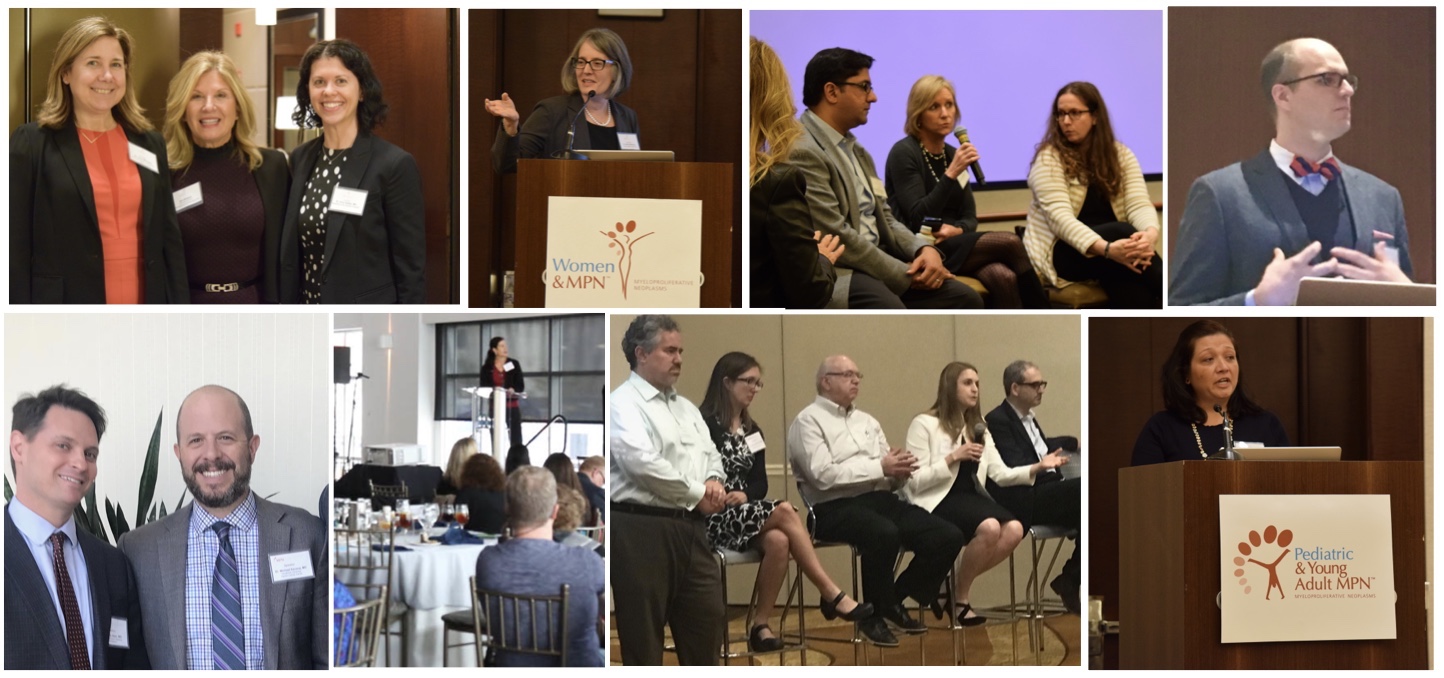
Click here to learn more about Pediatric and Young Adult MPNs

One Patient’s Point of View on “Living” with Myelofibrosis

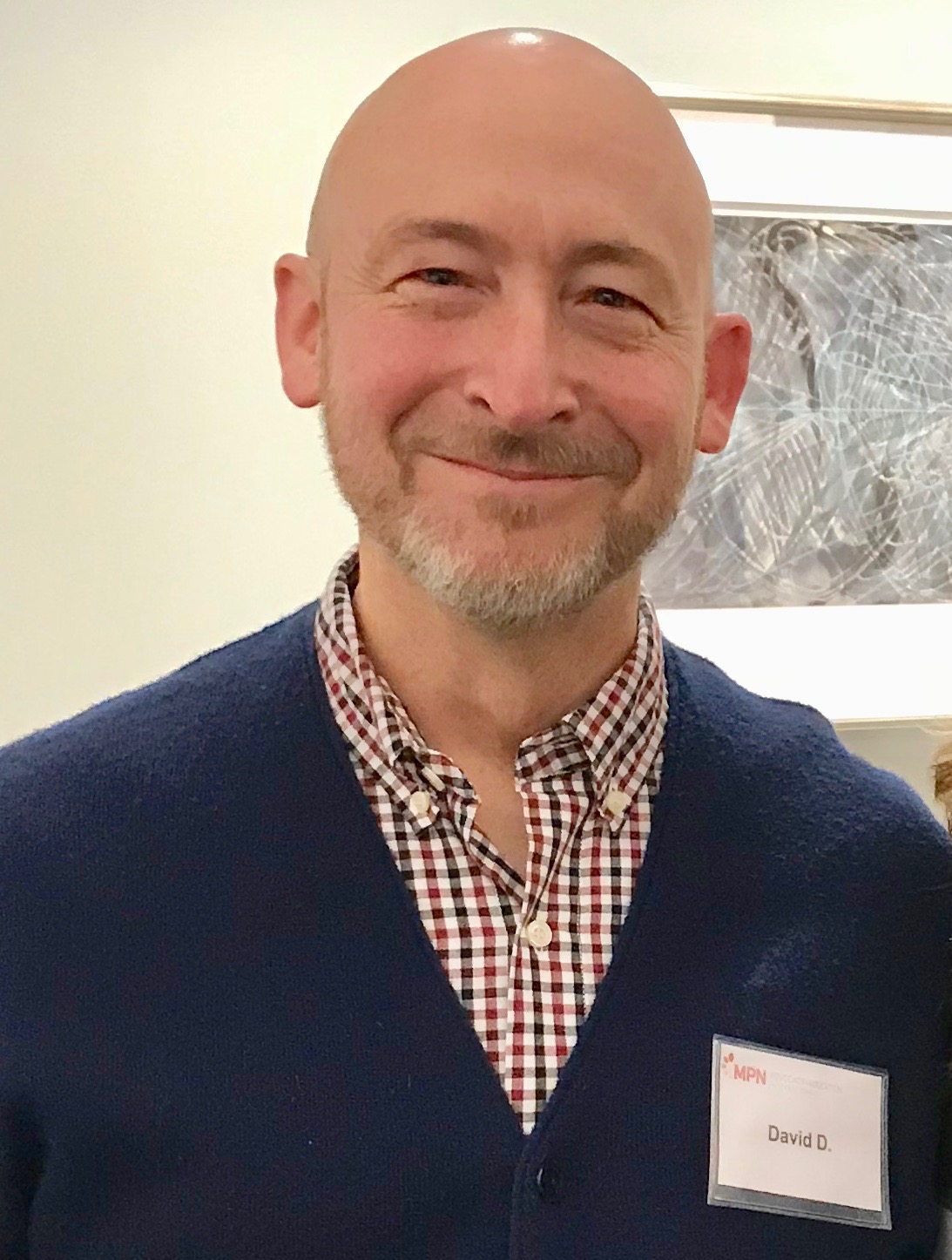
David told his story at the Cleveland MPN Patient Program in November

On a beautiful fall day in late August 2013, I received a call that changed the course of my life. The voice on the other end told me that they had reviewed my blood counts and determined that I had some sort of leukemia. They had pre-admitted me to the local hospital to meet an oncologist and have the necessary tests. After about two weeks I received my diagnosis of Primary Myelofibrosis, Intermediate 1. I was told that treatment options were limited and the only true cure was allogeneic bone marrow transplan

It is tempting to focus all our energies on our hope in medical interventions. But diagnosis brings fear, denial, anger, & depression. These impact your relationships and can throw you into a downward spiral. Being diagnosed with a life-threatening disease like an MPN is an existential challenge. It raises all the questions: Why are we here? What is life about? What lies beyond this life? How you answer these questions will affect how you deal with your disease and its physical effects.

We are all tempted to be sad and maybe even angry. But you do not have to give in to the negative. You can choose to respond with a positive attitude.


My diagnosis has changed the course of my life – but for the better. Because of myelofibrosis, I realized that I was spending far too much of my time and energy focused on some sort of future achievement. I was super-busy every day and the days passed in a blur. But myelofibrosis woke me up to the truth that life is not about some future achievement. Life is about today. Since my diagnosis, I have come to have a heightened enjoyment of the simple pleasures of daily living.

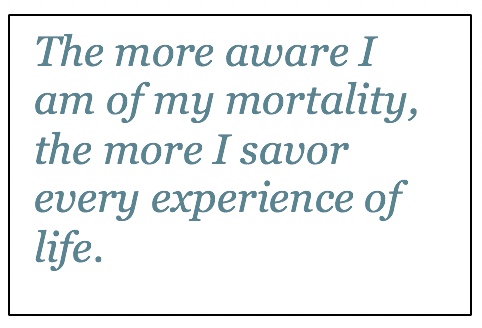
These last six years have been wonderful and I have enjoyed them more because of my disease. My son and his wife have been kind enough to give us two new grandchildren in the past four years – and I am making the most of that. I’ve made many good friends in the MPN community.  I took up motorcycle riding.  The more aware I am of my mortality – the more I savor every experience of life.

Your life only comes one day at a time. Today is the day you have – make it into something good. Refuse to let an uncertain future rob you of today’s joys.

David shared his story in the MPN Community Connection Newsletter click here to view


David is the support group coordinator for the northern Pennsylvania/Ohio area, if you are interested in participating you can contact us for more information. Click here to contact us.