
N-acetylcysteine inhibits thrombosis in a murine model of myeloproliferative neoplasm

Brianna M Craver 1Gajalakshmi Ramanathan 1Summer Hoang 1Xinyue Chang 1Laura F Mendez Luque 1Stefan Brooks 1Hew Yeng Lai 1Angela G Fleischman

January 2020

Abstract

Thrombosis is a major cause of mortality in patients with myeloproliferative neoplasms (MPNs), though there is currently little to offer patients with MPN beyond aspirin and cytoreductive therapies such as hydroxyurea for primary prevention. Thrombogenesis in MPN involves multiple cellular mechanisms, including platelet activation and neutrophil-extracellular trap formation; therefore, an antithrombotic agent that targets one or more of these processes would be of therapeutic benefit in MPN. Here, we treated the JAK2V617F knockin mouse model of polycythemia vera with N-acetylcysteine (NAC), a sulfhydryl-containing compound with broad effects on glutathione replenishment, free radical scavenging, and reducing disulfide bonds, to investigate its antithrombotic effects in the context of MPN. Strikingly, NAC treatment extended the lifespan of JAK2V617F mice without impacting blood counts or splenomegaly. Using an acute pulmonary thrombosis model in vivo, we found that NAC reduced thrombus formation to a similar extent as the irreversible platelet inhibitor aspirin. In vitro analysis of platelet activation revealed that NAC reduced thrombin-induced platelet-leukocyte aggregate formation in JAK2V617F mice. Furthermore, NAC reduced neutrophil extracellular trap formation in primary human neutrophils from patients with MPN as well as healthy controls. These results provide evidence that N-acetylcysteine inhibits thrombosis in JAK2V617F mice and provide a pre-clinical rationale for investigating NAC as a therapeutic to reduce thrombotic risk in MPN.
Read more


In Charleston, West Virginia, Tracking MPN Symptoms Becomes a Priority

January 17, 2025

Author(s): Mary Caffrey

When patients with myeloproliferative neoplasms (MPNs) must travel 2 hours for appointments with a cancer care team, capturing all their symptoms to ensure proper treatment is vital.

So, when Charleston Area Medical Center (AMC) Vandalia Health, located in Charleston, West Virginia, signed on to be part of the Association of Cancer Care Centers (ACCC) MPN Quality Improvement Program, systematic and accurate recording of patients’ symptoms was a priority. In a 12-month period, the cancer program serves 78 patients with polycythemia vera, 111 patients with essential thrombocythemia, and 48 patients with primary myelofibrosis.

Charleston AMC serves a large area in southern West Virginia, including some heavily rural areas. Its team includes general medical oncologists and hematologists who treat all types of cancers, 5 patient navigators, and 2 financial navigators who deal with insurance coverage, transportation issues, and other barriers to access. There is 1 social worker as well as nurses and other team members. Complementing the team are outside partners who help Charleston AMC meet multiple social needs.

As with ACCC Quality Improvement Program participants from Perlmutter Cancer Center at NYU Langone Health and Kent Hospital in Rhode Island, the multidisciplinary team in Charleston West Virginia, first took part in a webinar on MPN patient management.1

The ACCC Quality Improvement program was supported by Incyte.

The Charleston AMC team learned about the MPN Symptom Assessment Form Total Symptom Score (MPN-SAF TSS),2 a validated MPN patient-reported outcome tool that is recommended in the National Comprehensive Cancer Network Guidelines. Patients complete the assessment when they arrive at their appointments, giving providers an overview of symptoms that can be tracked over time.

Read more

RSK1 is an exploitable dependency in myeloproliferative neoplasms and secondary acute myeloid leukemia

Published January 16, 2025

Tim Kong, Angelo B. A. Laranjeira, Christopher T. Letson, LaYow Yu, Shuyang Lin, Jared S. Fowles, Daniel A. C. Fisher, Sherwin Ng, Wei Yang, Fan He, Minyoung Youn, et al.

Abstract

Myeloid malignancies are heterogenous disorders characterized by distinct molecular drivers but share convergence of oncogenic signaling pathways and propagation by ripe pro-inflammatory niches. Here, we establish a comprehensive transcriptional atlas across the spectrum of myeloproliferative neoplasms (MPN) and secondary acute myeloid leukemia (sAML) through RNA-sequencing of 158 primary samples encompassing CD34+ hematopoietic stem/progenitor cells and CD14+ monocytes. Supported by mass cytometry (CyTOF) profiling, we reveal aberrant networks of PI3K/AKT/mTOR signalling and NFκB-mediated hyper-inflammation. Combining ATAC-Seq, CUT&Tag, RNA-seq, and CyTOF, we demonstrate that targeting of ribosomal protein S6 kinase A1 (RSK1) suppresses NFκB activation and diminishes pro-inflammatory mediators including tumor necrosis factor (TNF) associated with MPN disease severity and transformation. We further evaluate a therapeutic approach utilizing a first-in-class RSK inhibitor, PMD-026, currently in Phase 2 development for breast cancer, for use in myeloid malignancies. Treatment with PMD-026 suppressed disease burden across seven syngeneic and patient-derived xenograft leukemia mouse models spanning the spectrum of driver and disease-modifying mutations. These findings uncover a therapeutic avenue for a conserved dependency across MPN and sAML.

Read more

Fedratinib for the treatment of myelofibrosis: a critical appraisal of clinical trial and “real-world” data

January 14, 2025

Adrian Duek, Ilona Leviatan, Osnat Jarchowsky Dolberg & Martin H. Ellis

Abstract

Fedratinib is a predominantly JAK2 inhibitor that has shown efficacy in untreated and ruxolitinib-exposed patients with myelofibrosis (MF). Based on randomized clinical trial data, it is approved for use in patients with International Prognostic Scoring System (IPSS) or Dynamic International Prognostic Scoring System (DIPSS) intermediate-2 or high-risk disease and is distinguished from ruxolitinib in that it can be administered without dose reduction in patients with thrombocytopenia, to a platelet count above 50,000/µL. In these trials, fedratinib achieved significant spleen volume reduction in ~30–45% of patients and improvement in total symptom scores in 35–40% with good tolerability. In contrast, recently published real-world data suggest that these responses may not be as robust outside clinical trials. In the context of routine clinical practice spleen responses are documented in only 13–68%, with varying degrees of symptom improvement. This may be due to the lack of a uniform definition of ruxolitinib failure, which may influence the timing of initiating fedratinib as a second-line treatment and result in a more prolonged exposure to ruxolitinib prior to intitaing fedratinib treatment. We suggest that given the growing number of drugs available for use in MF, recognizing the failure of first-line (and potentially subsequent) treatments is critical to allow timely transition to potentially more active agents, as highlighted by the data pertaining to fedratinib.

Read more


Arterial and Venous Thrombosis May Be Linked to More Aggressive MF

The impact of thrombosis on myelofibrosis (MF), mortality, and formation of solid tumors in myeloproliferative neoplasms (MPN) has been discussed in a new review article published in the Blood Cancer Journal.

For the review, the authors, led by Alessandro M. Vannucchi, MD, from Università di Firenze in Florence, Italy, analyzed large personal patient databases of MPN.

Arterial and venous thrombosis seem to be associated with a more aggressive disease course, they said.

Moreover, biomarkers of inflammation like the neutrophil-to-lymphocyte ratio seem to be associated with the aggressiveness of polycythemia vera and essential thrombocythemia, linking thrombosis to the risk of secondary cancer, the researchers added.

They suggested that this means there may be a common inflammatory pathway shared between cardiovascular diseases and cancer.

“These data underscore the need for new studies to validate these associations, delineate the sequence of events, and identify therapeutic targets to mitigate thrombotic events and potentially improve overall patient outcomes in [myeloproliferative neoplasms],” they concluded.

They highlighted the limitations of the viewpoint, including the fact that most of the studies that they reviewed were retrospective and the lack of investigations on the effect of cytoreductive therapy and associated comorbidities.

Read more

Building a Foundation of Trust in Patients With MPNs

By Darlene Dobkowski, MA
Fact checked by Spencer Feldman

For oncology nurses and APPs caring for patients with chronic conditions like MPNs, fostering a comfortable environment begins with active listening that extends beyond clinical data, an expert said.

Understanding the patient’s life outside the exam room—their sources of joy and their personal challenges—is essential for providing holistic care. Given the nature of MPNs, these providers often develop long-term relationships with patients, sometimes seeing them more frequently than they see their own families. Therefore, prioritizing the establishment of trusting relationships through deeper patient engagement is paramount for optimizing care and support throughout the patient’s journey.

Oncology Nursing News’ sister publication, CURE, spoke with Kathryn Johnson, DNP, MSc, FNP-BC, at the in-person MPN Heroes event to learn more about how connections like these can really benefit patients with MPNs.

Johnson is a Clinical Program Manager at Icahn School of Medicine at Mount Sinai New York.

Read more

Ropeginterferon Alfa-2b Effective in Phase 3 Essential Thrombocythemia Trial

By Jordyn Sava
Fact checked by Jason Broderick

The SURPASS-ET trial (NCT04285086), evaluating ropeginterferon alfa-2b (Besremi) in patients with essential thrombocythemia (ET), has achieved its primary endpoint, demonstrating a durable clinical response as defined by modified European Leukemia Net (ELN) criteria.1

In the intent-to-treat (ITT) population, 42.9% (39/91) of patients treated with ropeginterferon alfa-2b had durable responses at 9 and 12 months vs 6.0% (5/83) of patients enrolled in the comparator arm who were treated with anagrelide (Agrylin) (P =.0001).

For the secondary end point, the JAK2 V617F allele burden decreased from 33.7% to 25.3% (-8.4%) in the ropeginterferon alfa-2b group over 12 months, compared with a reduction from 39.7% to 37.3% (-2.4%) in the anagrelide group. These findings indicate that ropeginterferon alfa-2b may provide a more pronounced effect on mitigating the underlying disease pathology relative to anagrelide.

“We are extremely proud of the SURPASS-ET phase 3 study outcome, which shows the potential of [ropeginterferon alfa-2b] as an important new treatment option for patients with ET, a rare blood cancer that drastically increases the risk of heart attack or stroke,” said Ko-Chung Lin, PhD, founder and chief executive officer of PharmaEssentia, in a press release. “The data highlight the broad potential to apply our innovative monopegylated, long-acting interferon technology as a significant step forward for treating ET, and potentially other myeloproliferative neoplasms, with non-chemotherapy treatments.”

For safety, ropeginterferon alfa-2b did not lead to any treatment-related serious adverse events. Overall, the agent had a manageable safety profile.

Full trial results, including additional pharmacokinetics and biomarker data, are expected to be presented at a later date.

“The results of the SURPASS-ET trial are significant,” said Albert Qin, MD, PhD, chief medical officer, PharmaEssentia, in a press release. “ET is a challenging condition associated with symptoms and risks of thrombosis and disease progression. These encouraging results highlight the potential of [ropeginterferon alfa-2b] to provide an effective and tolerable new treatment option that we believe could provide a substantial clinical benefit for patients with ET. We plan to submit these results to the FDA and other regulatory agencies as soon as possible in hopes of providing this potential new treatment option to patients with ET.”

Read more

Ruxolitinib Combinations in MPNs: Updates From ASH

January 8, 2025

Author(s): Mary Caffrey

Following its approval in 2011 for myelofibrosis (MF), ruxolitinib (Jakafi, Incyte) became the backbone of treatment for MF and later for polycythemia vera (PV), 2 of the 3 common myeloproliferative neoplasms (MPNs).

But although ruxolitinib improves survival outcomes and quality of life, some patients may not respond to therapy, while others may stop due to genetic mutations, disease progression, or other factors. For years now, investigators have been studying the Janus kinase (JAK) inhibitor in combination with other drugs, both in first-line treatment and refractory disease. Abstracts and oral presentations at the recent 66th American Society of Hematology (ASH) Annual Meeting and Exposition, held December 7-10, 2024, in San Diego, California, offered updates on several combinations in the pipeline:

MANIFEST-2. Previous results from this phase 3 study (NCT04603495) of pelabresib, a selective bromodoman and extraterminal domain (BET) inhibitor, with ruxolitinib show it met its primary end point; in patients with MF not treated with a JAK inhibitor, a statistically significant higher proportion showed at least 35% reduction in spleen volume from baseline at week 24 with the combination vs ruxolitinib and placebo. Results presented at ASH showed those results were maintained after a median follow-up of 72 weeks, with a 48-week response rate of 57.0% for the combination vs 37.5% for ruxolitinib and placebo. An improvement in the Myelofibrosis Symptom Assessment Form total symptom score (TSS) by at least 50% was seen in 45.3% of patients receiving the combination vs 39.4% in the placebo group.1

Bomedemstat. An abstract at ASH reported on an ongoing phase 2 study (NCT05569538) involving bomedemstat combined with ruxolitinib in patients with advanced MF.2 Bomedemstat is an irreversible inhibitor of lysine-specific demethylase 1 (LSD1), which plays a role in gene regulation; blocking this enzyme alters cell differentiation and growth. In August 2024, Merck announced the second phase 3 trial of bomedemastat in another MPN, essential thrombocythemia (ET).

The abstract authors noted that about 50% of patients with MF stop ruxolitinib after 3 years, mostly due to disease progression or cytopenia; median OS after discontinuation is 14 months.2 LSD1, they write, is “critical for self-renewal” of cancerous stem cells, and has shown promise as a single agent. This study reported on 2 cohorts: Cohort A had a suboptimal response to ruxolitinib, and cohort B patients had MF and were treatment naive. Patients in cohort A remained on the entry dose of ruxolitinib while cohort B started 10 mg twice per day; all patients received a starting dose of 0.4 mg/kg/day of bomedemstat. Dose adjustments were permitted every 4 weeks to achieve an optimal platelet count; downward titrations were done at any time for safety reasons. After a median of 61.7 weeks, in 40 evaluable patients, at week 24, 11 patients had at least a 50% improvement in TSS, with 25.9% in cohort A and 30.7% in cohort B; 17.5% had at least 35% spleen volume reduction, with 7.4% in cohort A and 38.5% in cohort B; and 50% of patients had stable or improved hemoglobin (51.9% in cohort A and 46.3% in cohort B). There were no safety signals or deaths related to the drug, the authors said.2

Read more

Baseline Basophilia Associated With Aggressive MPN and Poor Outcomes

A more aggressive disease phenotype and poorer clinical outcomes were associated with higher baseline basophil levels among patients with myeloproliferative neoplasms (MPNs), according to the results of a retrospective study published in the American Journal of Hematology.

In the study, researchers analyzed data from 195 patients who were diagnosed with an MPN between 2008 and 2019 at a single center. Cases of chronic myeloid leukemia, chronic eosinophilic leukemia, and chronic neutrophilic leukemia were excluded. Basophilia was defined as a relative or absolute increase in peripheral blood or bone marrow aspirate within 6 months of the patient’s first diagnostic biopsy.

Of the 195 patients, 40.5% had essential thrombocythemia (ET), 23.1% had overt fibrotic phase primary myelofibrosis (PMF), 10.8% had post-ET myelofibrosis (MF), 8.2% had pre-fibrotic PMF, 8.2% had MPN-unclassifiable (MPN-U), 7.2% had polycythemia vera (PV), and 2.1% had post-PV MF.

Basophilia were present among 22% of patients. The lowest level of basophilia was present among patients with ET and PV at 8% compared with 35% among patients with pre-PMF, F-PMF, post-ET MF, post-PV MF, or MPN-U (P <.0001). There were 9% of patients who demonstrated basophilia in the bone marrow, but not the blood.

Of the patients without basophilia at baseline, researchers found that 12% developed basophilia within a median of 19.6 months after diagnosis. Older age (P <.001), higher white blood cell count (P <.001), higher reticulin grade (P =.0007), lower hemoglobin levels (P =.01), and lower platelet counts (P <.001) were significantly associated with basophilia.

Read more

Understanding Thrombocytosis in MPN Patients: What You Need to Know

For patients living with myeloproliferative neoplasms (MPNs), the term “thrombocytosis” often arises. While thrombocytosis—an elevated platelet count—is a hallmark of some MPNs like essential thrombocythemia (ET), it can also appear in other forms of MPNs or even due to unrelated secondary causes. Understanding the different contexts in which thrombocytosis occurs is key to effective management and improving quality of life.

Thrombocytosis in MPNs: A Common Feature

1. Essential Thrombocythemia (ET)

  • Primary Cause of Thrombocytosis: In ET, the overproduction of platelets is driven by genetic mutations such as JAK2, CALR, or MPL in the stem cells of the bone marrow.
  • Platelet Levels: Platelet counts in ET are persistently elevated, often exceeding 450,000/μL, and can reach over 1,000,000/μL.
  • Risk of Complications: ET-associated thrombocytosis increases the risk of blood clots (thrombosis) and bleeding due to dysfunctional platelets.

2. Polycythemia Vera (PV)

  • Secondary Thrombocytosis: PV primarily involves elevated red blood cell counts, but platelet counts are often high as well. This occurs because of the overactivity of the bone marrow, commonly linked to the JAK2 mutation.
  • Complications: In PV, elevated platelets further amplify the risk of clotting, especially when combined with high red blood cell counts.

3. Myelofibrosis (MF)

  • Variable Platelet Counts: In early stages of MF, thrombocytosis may occur due to hyperactive bone marrow. However, as the disease progresses and fibrosis (scarring) of the bone marrow develops, platelet counts often drop (thrombocytopenia).
  • Implications: Elevated platelets in early MF contribute to the overall risk of thrombosis but are usually less prominent than in ET or PV.

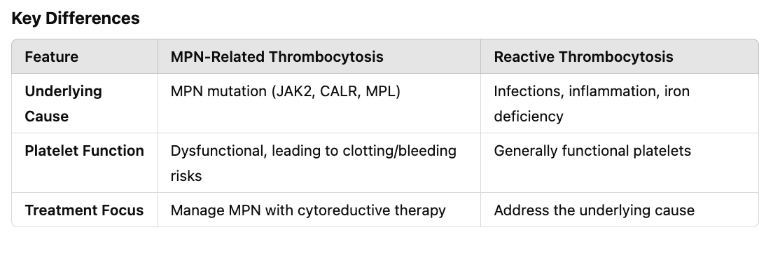
Thrombocytosis in MPNs vs. Reactive Thrombocytosis

MPN patients may also develop reactive thrombocytosis, where platelet levels rise due to an external trigger rather than the disease itself. This is important to differentiate, as the treatment approach varies.

Causes of Reactive Thrombocytosis in MPN Patients:

  • Infection: Common colds, bacterial infections, or systemic inflammation.
  • Iron Deficiency: Iron depletion, often seen in PV due to phlebotomy or blood loss, can elevate platelet counts.
  • Surgery or Trauma: Any significant physical stress can temporarily increase platelet production.
  • Inflammatory Conditions: Co-existing autoimmune diseases or inflammatory processes.

Managing Thrombocytosis in MPN Patients

For MPN patients, managing thrombocytosis involves addressing both the underlying condition and associated risks:

1. Medications to Control Platelet Levels

  • Low-Dose Aspirin: Reduces the risk of clotting in patients with high platelet counts and cardiovascular risks.
  • Cytoreductive Therapy: Drugs like hydroxyurea or anagrelide may be prescribed to reduce platelet counts in high-risk patients.
  • JAK Inhibitors: For conditions like PV or MF with thrombocytosis, drugs like ruxolitinib target the underlying JAK2 pathway.

2. Monitoring and Prevention

  • Regular Blood Tests: Monitoring platelet counts and clotting markers is crucial.
  • Lifestyle Modifications: Staying active, avoiding smoking, and maintaining a healthy weight can help reduce clotting risks.
  • Avoiding Triggers: Identifying and managing secondary causes like iron deficiency or inflammation can prevent exacerbation.

3. Managing Complications

  • Clotting Risks: Thrombocytosis in MPNs increases the risk of strokes, heart attacks, and deep vein thrombosis (DVT). Prompt treatment of symptoms like chest pain, shortness of breath, or limb swelling is essential.
  • Bleeding Risks: Paradoxically, MPN patients with thrombocytosis may experience bleeding due to abnormal platelet function, such as nosebleeds, gum bleeding, or gastrointestinal bleeding. Report unusual bleeding to your healthcare provider immediately.

Living with Thrombocytosis as an MPN Patient

Thrombocytosis in the context of MPNs requires long-term management, but there are steps you can take to improve your quality of life:

  • Stay Informed: Learn about your specific MPN and its implications for thrombocytosis.
  • Build a Support Network: MPNs are rare conditions. Connecting with support groups or online communities can provide emotional support and practical advice.
  • Communicate with Your Care Team: Keep an open dialogue with your hematologist, and don’t hesitate to ask about treatment options, clinical trials, or lifestyle recommendations.

Thrombocytosis in MPN patients is more than just a high platelet count—it’s a complex condition with significant implications for your health. Understanding the nuances of your condition is essential for effective management, whether it’s caused by essential thrombocythemia, polycythemia vera, or reactive triggers. By working closely with your healthcare team and staying proactive in your care, you can navigate the challenges of thrombocytosis and live a fuller, healthier life.