
National Health Expenditure Associated With Myeloid Neoplasms Survival in Europe

An analysis of the EUROCARE found that lower total national health expenditure (TNHE) was associated with shorter survival among patients with some types of myeloid neoplasms (MNs), according to a report published in the European Journal of Oncology.

The researchers also reported that 10-year relative excess risk of death (RER) was generally higher for patients in regions with lower TNHE.

EUROCARE-6 is a dataset in the EUROCARE study that is derived from 27 European countries of patients aged 15 or older diagnosed with an MN between 2001 and 2013. MNs included acute myeloid leukemia (AML), myeloproliferative neoplasms (MPNs), chronic myeloid leukemia (CML), polycythemia vera (PV), essential thrombocythemia (ET), and myelodysplastic syndrome (MDS).

There were a total of 267,968 MN cases in the dataset, of which, 41.1% were AML, 32.2% were MPNs, 11.7% were CML, 6.8% were PV, 7.4% were ET, and 19.6% were MDS, and 4.4% were MDS/MPN.

Countries in the lowest TNHE quartile included Bulgaria, Croatia, Estonia, Latvia, Lithuania, Poland, and Slovakia. Countries in the highest TNHE quartile included Austria, Denmark, Germany, Norway, and Switzerland. The median follow-up was 13 years.

At 10 years, the age-standardized relative survival (ASRS) ranged from 61.2% for MPNs to 15.6% for AML. Within MPNs, the 10-year ASRS was 75.2% for ET, 70.9% for PV, and 52.5% for CML.

Countries in the lowest TNHE quartile demonstrated lower 10-year ASRS rates compared with countries in the highest quartile for AML, MPN, and MDS.

A similar trend was observed for 10-year RERs for most MNs, with higher RERs associated with lower TNHE quartile. For example, the lowest TNHE quartile was significantly associated with a greater 10-year RER for MPN (RER, 1.32; 95% CI, 1.30-1.35), AML (RER, 1.28; 95% CI, 1.25-1.31), and acute promyelocytic leukemia (RER, 1.42; 95% CI, 1.12-1.80).

The highest quartile was significantly associated with lower 10-year RER for MPN (RER, 0.80; 95% CI, 0.78-0.81) and AML (0.86; 95% CI, 0.84-0.88), but not some subtypes of AML and APL.

“TNHE is associated with geographical inequalities in MN prognosis,” the researchers concluded in their report. “Policy decisions on allocating economic resources are needed to reduce these differences.”

Read more

Biomed Valley Discoveries Announces First Patient Dosed in Phase 1/2 Combination Study of Ulixertinib with Ruxolitinib (Jakafi®) in Patients with Myelofibrosis

Provided by GlobeNewswire  

— Dual targeting of JAK 1/2 (ruxolitinib) and ERK 1/2 (ulixertinib) may represent a novel treatment approach for myelofibrosis and possibly other myeloproliferative neoplasms

KANSAS CITY, Mo., April 28, 2025 (GLOBE NEWSWIRE) — Biomed Valley Discoveries (BVD), a clinical-stage biotechnology company guided by its founders’ intent of bringing hope for life to patients, today announced that the first patient has been dosed in a Phase 1/2 combination study of ulixertinib, BVD’s highly selective, first-in-class ERK 1/2 inhibitor with ruxolitinib, a JAK1/JAK2 inhibitor for the treatment of myelofibrosis, a rare type of bone marrow cancer that disrupts the body’s normal production of blood cells.

Raajit Rampal, M.D., Ph.D., a hematologist-oncologist with Memorial Sloan Kettering Cancer Center who specializes in the treatment of myeloproliferative neoplasms and leukemia, is the lead principal investigator for this investigator-initiated trial.

“We’re thrilled to announce the milestone of first patient dosed in this trial, and grateful for the opportunity to collaborate with Dr. Rampal and Incyte to explore the potential of ERK inhibition as a complement to JAK inhibition for the treatment of patients with myelofibrosis,” said Brent Kreider, Ph.D., President of BVD. “This trial helps further our commitment to fully interrogate the potential of direct ERK inhibition to address unmet patient needs in various cancer settings where MAPK signaling is implicated.”

Read more

Disc Medicine to Host Webinar with Key Opinion Leaders on Anemia of Myelofibrosis (MF)

Disc Medicine Inc – (GLOBE NEWSWIRE)

April 29, 2025

WATERTOWN, Mass., April 29, 2025 (GLOBE NEWSWIRE) — Disc Medicine, Inc. (NASDAQ:IRON), a clinical-stage biopharmaceutical company focused on the discovery, development, and commercialization of novel treatments for patients suffering from serious hematologic diseases, today announced it will host a virtual KOL investor event on Friday, May 9 at 1:00 PM ET / 10:00 AM PT to provide an overview of anemia of myelofibrosis (MF) and discuss the evolving treatment landscape for this disease. The event will also include an overview of Disc’s clinical data and development plans for DISC-0974 in MF anemia.

Intended for investors and other interested audiences, the virtual event will feature presentations from leading experts on myeloproliferative neoplasms (MPNs), including MF. The KOL speakers will provide an overview of MF anemia, its epidemiology, pathogenesis, and impact on patients, then discuss the current and emerging therapeutic landscape for MF and highlight the clear unmet need for anemia-focused treatments. Invited speakers include:

  • Dr. Aaron Gerds, M.D., M.S., a hematologist-oncologist at Cleveland Clinic and associate professor at Case Western University School of Medicine, where he runs the cancer center’s Clinical Research Office. Dr. Gerds has been a principal investigator in various clinical trials for MPNs.
  • Dr. Prithviraj Bose, M.D., a professor at MD Anderson Cancer Center with a focus on MPNs. Dr. Bose has been a leader in multiple clinical trials in myelofibrosis.

Members of Disc’s leadership team will review the therapeutic rationale for DISC-0974, summarize clinical data from the Phase 1b trial of DISC-0974 in MF anemia originally presented at the 2024 American Society of Hematology (ASH) annual meeting, discuss the design for its ongoing Phase 2 trial, and reiterate expected timing for an interim Phase 2 data readout in 2025. Management will also provide a view of the expected market opportunity and positioning for DISC-0974 in MF anemia.

A live webcast of the event will be available in the Events and Presentations section of the Investor Relations page of Disc’s website (https://ir.discmedicine.com/). A webcast replay will be available after the live presentation and will be accessible for 90 days. Please register for the event on the Events and Presentations page of Disc’s website ( https://edge.media-server.com/mmc/p/5c72d8fu ).

Read more

Molecular predictors of venous and arterial thrombotic events in patients with myelofibrosis

Olga Morath, Jenny Rinke, Annabell Walter, Carl Crodel, Manja Meggendorfer, Constance Baer, Andreas Hochhaus & Thomas Ernst

Abstract

While patients with myelofibrosis (MF) face an elevated risk of thrombosis, no validated scoring system currently exists to effectively assess this specific risk. This study aimed to explore distinct molecular risk factors for arterial (ATE) and venous (VTE) thrombosis in a cohort of 141 MF patients. Mutation analysis was performed by next-generation sequencing for a panel of 30 target myeloid genes as previously described: 137 driver and 164 non-driver mutations were detected. JAK2-V617F was identified in 77 (55%) patients, CALR in 45 (32%) patients, and seven (5%) patients carried an MPL variant. Patients #58 and #60 harbored JAK2-V617F and MPL; and patient #67 was positive for all three driver genes. The JAK2V617F variant allele frequency (VAF) was assessed in 66/80 patients, revealing a median of 34.0% (range, 5.0–96.0). ASXL1 (n = 34 patients) were the most common non-driver mutations, followed by TET2 (n = 26), U2AF1 (n = 12), and DNMT3A (n = 11). During a median follow up of 4.8 years, 24 (17%) patients experienced VTE, 15 (11%) ATE, and two patients experienced both. Among the 24 patients with VTE, 12 (50%) experienced splanchnic vein thrombosis. The JAK2-V617F mutation was associated with VTE (OR 2.6, 95% CI 1.01–7.16), while the DNMT3A mutation was an independent predictor of ATE (OR 5.40, 95% CI 1.30-22.42). High JAK2-V617F VAF (> 50%) was not related with an increased thrombotic risk. Results of this study demonstrate the significance of DNMT3A mutations as an independent molecular risk factor for ATE, highlighting the potential to include these somatic non-driver mutations in future thrombosis risk scores.

Read more


Fatigue, Quality of Life Improve With Rusfertide: Andrew Kuykendall, MD

April 27, 2025

Author(s): Maggie L. Shaw, Andrew Kuykendall, MD

Bringing this interview with Andrew Kuykendall, MD, clinical researcher at Moffitt Cancer Center, to a close, he addresses safety concerns that have been linked to the injectable hepcidin mimetic rusfertide (Takeda) and its overall impact on patient quality of life. Rusfertide is under investigation for treatment of polycythemia vera, a myeloproliferative neoplasm, in the ongoing phase 3 VERIFY trial (NCT05210790), on which Kuykendall is an investigator.

Previous segments of this interview focused on managing polycythemia vera, understanding hematocrit thresholds, reducing thrombotic risk, and reducing patient dependence on phlebotomy.

Read more

Prediction of resistance to hydroxyurea therapy in patients with polycythemia vera: a machine learning study (PV-AIM) validated in a prospective interventional phase IV trial (HU-F-AIM)

Published April 25, 2025

Florian H. Heidel, Valerio De Stefano, Matthias Zaiss, Jens Kisro, Eva Gückel, Susanne Großer, Mike W. Zuurman, Kirsi Manz, Kenneth Bryan, Armita Afsharinejad, Martin Griesshammer & Jean-Jacques Kiladjian

Abstract

Polycythemia vera (PV) is a myeloproliferative neoplasm associated with increased thromboembolic (TE) risk and hematologic complications. Hydroxyurea (HU) serves as the most frequently used first-line cytoreductive therapy worldwide; however, resistance to HU (HU-RES) develops in a significant subset of patients, leading to increased morbidity and necessitating alternative treatments. This study, part of the PV-AIM project, employed machine learning techniques on real-world evidence (RWE) from the Optum® EHR database containing 82.960 PV patients to identify baseline predictors of HU-RES within the first 6–9 months of therapy. Using a Random Forest model, the study analyzed data from 1850 patients, focusing on laboratory parameters and clinical characteristics. Key predictive markers included red cell distribution width (RDW) and hemoglobin (HGB), showing the strongest association with HU-RES. A synergistic interaction between RDW and HGB was identified, enabling TE risk stratification. This study provides a robust framework for early detection of HU-RES using readily available clinical data, facilitating timely intervention. These findings underscore the importance of personalized treatment approaches in managing PV and highlight the utility of machine learning in enhancing predictive accuracy and clinical outcomes. Based on the results of PV-AIM we initiated an open-label, prospective, single-arm, interventional, phase IV study (HU-F-AIM) evaluating HU-resistance/intolerance. Validation of predictive biomarkers may facilitate identification of patients at risk of HU resistance who may benefit from alternative treatment options, possibly preventing ongoing phlebotomy during HU treatment, a frequent therapeutic choice in high-risk PV associated with early disease progression and increased thromboembolic complications. We propose an updated terminology that differentiates between true molecular resistance and clinical resistance, that may indicate the requirement for alternative therapeutic strategies.

Read more


As-Expected Ruxolitinib Starting Dose Outperforms Lower Dosage in Myelofibrosis

By Bridget Hoyt
Fact checked by Kristie L. Kahl

Patients with myelofibrosis who were treated with the expected starting dose of ruxolitinib (Jakafi) demonstrated higher spleen response rates and a shorter median time to first response vs patients receiving a less-than-expected starting dose, per data from the ROMEI trial.

Additionally, overall survival (OS) was not reached in the as-expected group; however, patients in both groups reduced daily dosages over 12 months in the multicenter, observational, ongoing study, according to findings published in Cancer.

“To ensure optimal treatment with ruxolitinib, patients should be started on appropriate ruxolitinib doses and maintain the highest tolerated dose for maximum effectiveness,” wrote the study authors. “Patients who received the recommended doses showed a better trend in response.”

Trial Design and Key Data

The trial enrolled 508 adult ruxolitinib-naive patients who had been diagnosed with primary or secondary myelofibrosis across 51 centers in Italy between April 2017 and May 2022, at which time ruxolitinib was the only FDA-approved JAK inhibitor for myelofibrosis.

Patients with available baseline platelet counts were stratified into the as-expected (n = 174) and lower-than-expected (n = 132) dosage groups, resulting in 43% of patients receiving a lower-than-expected dose.

Changes in symptoms and health-related quality of life (HRQOL), assessed using Myeloproliferative Neoplasm 10 total symptom score (MPN-10 TSS) and EuroQol5-Dimension 5-Level (EQ-5D-5L), respectively, were primary end points of the study.

Read more

Diagnosis and Management of PV and ET in Pediatric Populations Needs Improvement

Polycythemia vera (PV) and essential thrombocythemia (ET) are rarely diagnosed in children, adolescents, and young adults. As the median age at diagnosis for these conditions is usually over 60 years, few pediatricians are familiar with their clinical, biological, and genetic features.1-3 Early diagnosis is essential to assess the need for specialized treatments and to prevent long-term complications, such as hemorrhage, thrombosis, or progression to secondary malignancies.1

In a 2-part study published in the European Journal of Pediatrics, Agathe Picard, MD, of the department of pediatric oncohematology at the Rennes University Hospital in France, and colleagues, analyzed practices around the diagnosis and management of pediatric patients with PV and ET in France.

Methodology and Study Design

In the first part of the study, a national practice survey about pediatric patients diagnosed with PV or ET was performed. The 8-question survey was sent to all pediatrician members of the leukemia committee of Société Française de lutte contre les Cancers et leucémies de l’Enfant et de l’adolescent (SFCE), and all hematologist members of France Intergroupe des Syndromes Myéloprolifératifs (FIM).

AYA [patients] should be referred to specialized units that consider the social, psychological, and educational needs of these patients.

In the second part, a retrospective cohort study was conducted at 7 pediatric oncohematology departments in western France. The researchers analyzed clinical, biological, and genetic data, as well as treatment and complication patterns from 17 pediatric patients with PV or ET, all of whom were diagnosed before the age of 18.

Read more

Assessing Risk for JAK Inhibitor Selection in Myelofibrosis

By Targeted Oncology Staff

In part 1, experts explores how assessing individual risk factors is crucial in selecting the appropriate JAK inhibitor for patients with myelofibrosis.

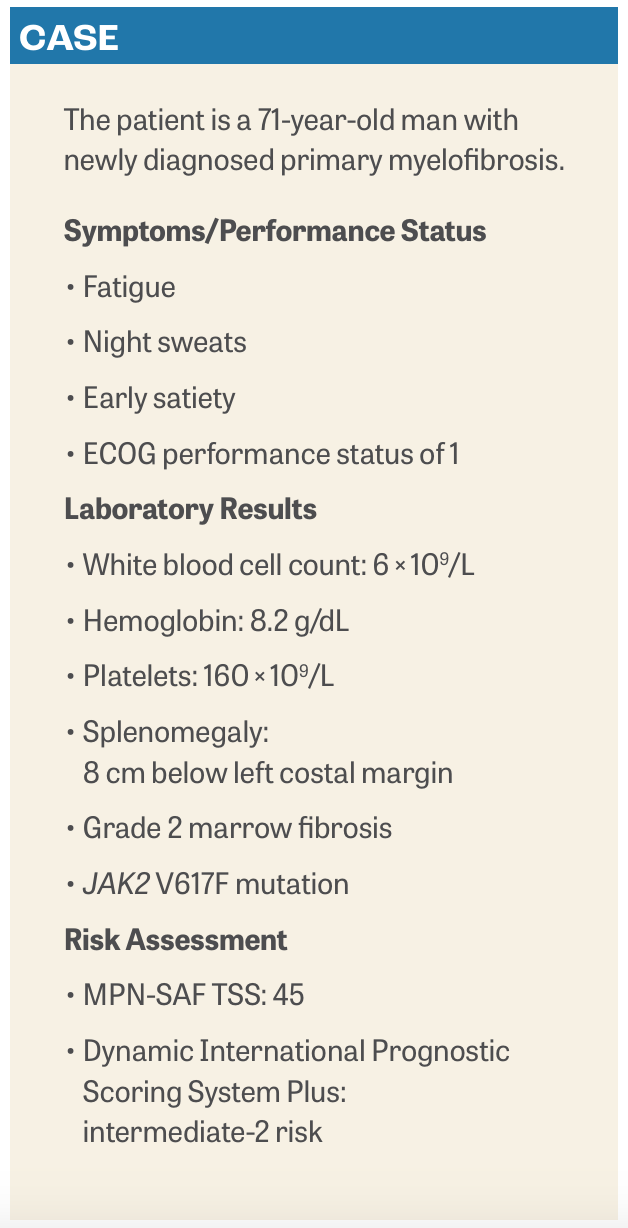
CASE

AARON T. GERDS, MD, MS: How do you use molecular testing, bone marrow results, and clinical features to stratify risk in patients with myelofibrosis?

PRITHVIRAJ BOSE, MD: At this point, I believe we are all receiving the myeloid mutation panels. We also order JAK2MPL, and CALR: the 3 drivers. However, most clinicians would order a myeloid mutation panel because we know that many of the mutations are prognostic. This is the whole point of risk stratification, which is now increasingly sophisticated and integrates multiple clinical, molecular, [and] cytogenetic variables to determine who needs a transplant.

These are the first actions I take when speaking with a new patient. I get an idea of their risk in terms of survival and prognosis, and that informs my decision to refer them to transplant. I then counsel the patient appropriately.

I do not believe molecular testing informs treatment because our drugs are, for the most part, mutation agnostic. All we have are JAK inhibitors, which are not mutation specific. However, from a prognostic standpoint, the [role] of molecular testing is key.

Read more

Working to Address Unmet Medical Needs in MPNs

April 24, 2025

Author(s): John Crispino

Fact checked by: Alex Biese, Spencer Feldman

In his research into myeloproliferative neoplasms, or MPNs, John Crispino is focused on a couple of key areas when it comes to understanding the underlying biology of the disease, as he explained in an interview with CURE.

Crispino is the director of the division of experimental hematology at St. Jude Children’s Research Hospital in Memphis, Tennessee, where he is also the Wall Street Committee Endowed Chair and principal investigator of the Crispino Lab. The Crispino Lab, according to its website, is focused primarily on myeloid cells, centered on the mechanisms of normal and abnormal cell development.

“There are two major areas that we study,” Crispino told CURE. “The first is the biology of megakaryocytes. Those are the cells that make platelets. … The second major area of research is on leukemic progression. So I would say that that progression to acute leukemia is really terrible outcome for patients, and we have very few therapies for patients that do advance at that stage. So our research in the past few years has focused on understanding the mechanism.”

Crispino sat down recently with CURE to discuss his research.

Read more